



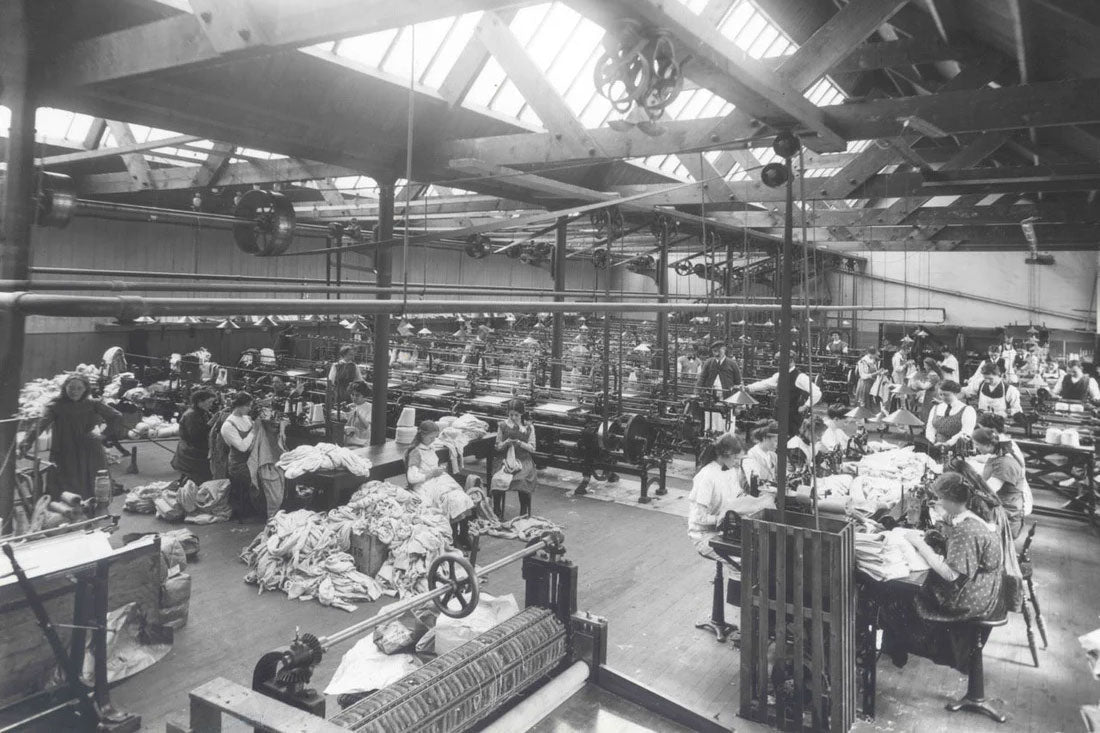
When Bailie John Hardie introduced the first stocking frames to Hawick in 1771, he could not have imagined what he was about to create. In less than 100 years the town was to be at the very heart of the knitwear trade in Scotland. Textiles expansion continued with foreign markets being conquered and in the 1960’s Hawick became the highest earning town in the United Kingdom per head of population.
Of course, there was hand knitting in Hawick long before 1771, but this is the date given for the foundation of the textile industry in Hawick. This marks the introduction of stocking frames to the town by Bailie John Hardie, a merchant who had found them being used in the west of Scotland.
In the beginning, these stocking frames would be used by out-workers in their own homes but increasingly waterpower and steam power saw machinery being concentrated alongside the rivers. By 1800 up to 3,000 people were employed in Hawick producing hosiery, carpets, linen and woollen goods. During the second half of the 1800’s steam power began to replace waterpower and the size and number of mills grew further.
Rail transport came to Hawick in 1849 with the arrival of the line from the Lothian coalfield. Significantly the onward connection from Hawick to Carlisle, completing the Waverley Line, was not made until later, in 1862.
The scale of the textile industry in Hawick grew to such a size, that by 1870 over a million pounds in weight of wool was being turned each year into a range of goods. Production was not restricted to knitwear and tweed became highly popular in the early and mid 1800’s with weaving being established in Hawick with similar success.
Stockings ‘grew’ into combination underwear, and then into outerwear: pullovers, cardigans, and the famous twin-set. With the growth of the industry came an influx of workers and Hawick’s population peaked at 19,800 in 1891, when it is worth remembering the area of the town was a fraction of its present size.
The Pringles had founded their enterprise in 1815, and other manufacturers steadily followed. These included Barrie, Innes Henderson, Lyle & Scott, Peter Scott, Robert Noble on the knitwear side, and Blenkhorn Richardson and Wilson & Glenny for making worsted cloth. Those examples all bear individual family names reflecting pride in the quality of the product, and there came to be many other family businesses during a long period until the end of the 20th Century.
Times may have changed, but to this day, Hawick’s success has been built on a highly skilled workforce producing top quality products, with manufacturers leading the way in both innovation and design.

Photo credits: From the collections of Scottish Borders Council, administered by Live Borders (Hawick Museum).


