



from Teviot Knitwear Director, Kevin Barrie
It is a pleasure to introduce myself to you. I have worked in the knitwear industry for almost 40 years and am highly experienced in all aspects of manufacturing, with a particular expertise in knitting and the craft of Hand Intarsia.
In this article, I explain the history of intarsia knitting, how it works and discuss its links to the Scottish Borders. As a small artisan manufacturer, it is my role to lead the team in pushing the boundaries of what is possible and there is no doubt that the skilled craft of hand intarsia enables us to realise the most complex designs with world class quality.
The history of intarsia knitting
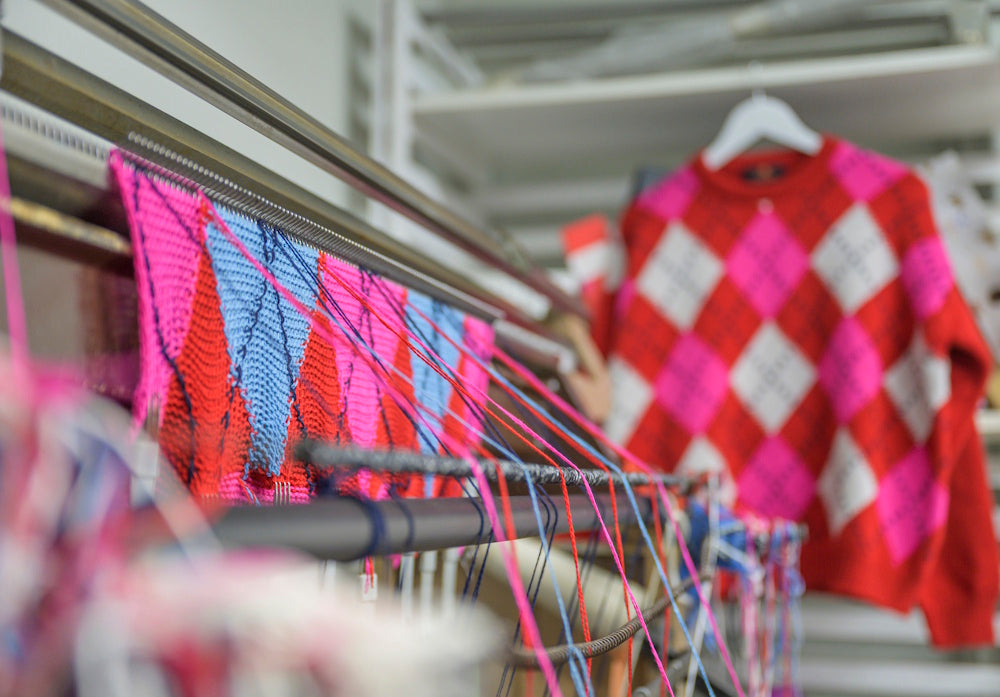
Intarsia knitting is one of the most striking and artistic forms of colourwork. Unlike stranded knitting, where unused yarn is carried across the back of the fabric, intarsia uses separate lengths or bobbins of yarn for each distinct area of colour. The result is a smooth, lightweight fabric with crisp colour changes, making it ideal for bold geometric designs, landscapes, florals, lettering and pictorial motifs.
The name intarsia comes from the Italian word describing the decorative art of inlaid woodwork, where contrasting pieces of wood are carefully fitted together to create intricate patterns. The knitting technique follows the same principle, with blocks of coloured yarn fitting neatly together like the pieces of a jigsaw puzzle.
Although the term intarsia is relatively modern, the colourwork method itself has existed for much longer. Historical evidence suggests that knitters have been creating separate blocks of colour in garments for centuries, even if the technique was not always known by its current name. Knitting itself arrived in Scotland towards the end of the medieval period and became an important domestic and commercial industry from the sixteenth century onwards. Scottish bonnet makers, stocking knitters and later the famous regional knitting traditions helped establish Scotland as one of Europe's leading centres of wool craftsmanship.
How intarsia works
The defining feature of intarsia is that each area of colour has its own yarn supply. Instead of carrying yarn across the reverse of the work, as in Fair Isle knitting, the knitter twists the old and new yarns together at each colour change to prevent holes forming between colour blocks. Because there are no long floats on the back, intarsia is particularly suitable for large areas of solid colour.
Traditional hand knitters often use small bobbins to keep each yarn separate and prevent tangling. While the technique requires careful organisation, it produces beautifully flat, flexible fabric and allows almost unlimited freedom of design. Large motifs such as flowers, animals, landscapes or abstract artwork can all be incorporated into a garment without adding unnecessary thickness.
Intarsia and the Scottish Borders
Few places are more closely associated with luxury knitwear than the Scottish Borders. Towns such as Hawick have been at the heart of Scotland's textile industry since the nineteenth century, building international reputations for exceptional woollen and cashmere garments.
Hawick became renowned for fine knitwear manufacturing, including a particularly strong reputation for hand intarsia production. Highly skilled craftspeople perfected a remarkable method of creating intricate multicoloured knitwear using manually operated Dubied knitting machines. Rather than relying on computer programming, each coloured section is laid onto the machine by hand before every row is knitted. This painstaking process allows far more complex designs than many automated systems can achieve and preserves the character of true hand-crafted intarsia.
This tradition continued in the Borders for over two centuries, with specialist mills such as Teviot Knitwear still maintaining techniques that have largely disappeared elsewhere. Today, luxury fashion houses continue to commission us to produce high-quality hand-intarsia garments because of the exceptional skill involved.
Intarsia compared with Fair Isle
Because both techniques use multiple colours, intarsia is often confused with Fair Isle knitting. However, they are fundamentally different.
Fair Isle knitting, which originated on the Shetland island of the same name, uses two colours in each row, with unused yarn carried across the back of the work as floats. It is best suited to small, repeating geometric motifs and creates a double layer of yarn that provides warmth and durability.
Intarsia, by contrast, has no carried floats. Each block of colour is worked independently, allowing knitters to create large images and bold designs without unnecessary bulk. Many modern garments combine both techniques, using Fair Isle borders alongside intarsia motifs to achieve striking decorative effects.
A Living Craft
Although modern digital knitting machines can reproduce many colourwork designs, hand intarsia remains one of the most respected skills in the textile industry. It requires precision, patience and years of experience, particularly when producing complex luxury garments.

We are proud that this heritage continues to thrive at Teviot Knitwear. The region's long association with fine wool, cashmere and expert craftsmanship has ensured that hand intarsia remains more than simply a knitting technique - it is part of a living textile tradition that connects contemporary fashion with centuries of Scottish innovation and artistry.
As appreciation grows for slow fashion, sustainable production and traditional craftsmanship, intarsia knitting continues to demonstrate that the finest textiles are created not only through technology, but through the remarkable skill of the people who make them.
See our Intarsia range
See our Argyle range
See our Fair Isle range


