



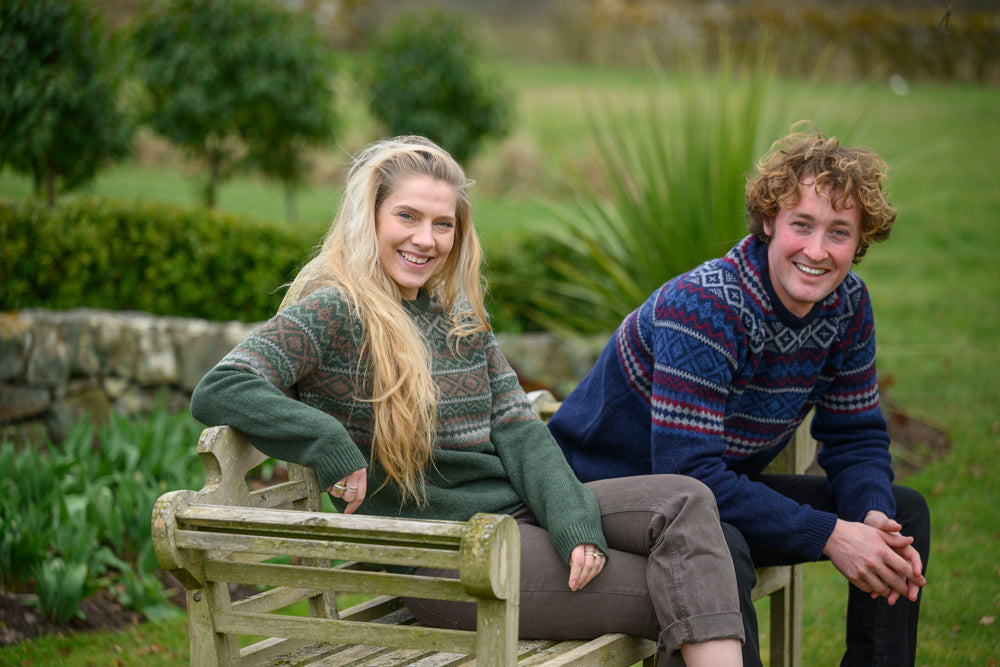
Few knitting traditions are as instantly recognisable as Fair Isle. With its rhythmic bands of colourful geometric motifs and exceptional craftsmanship, Fair Isle knitting has become an enduring symbol of Scottish textile heritage. While its origins lie on one of Britain's most remote islands, the technique found a second home in the textile mills of the Scottish Borders, where it evolved from a practical island craft into a luxury fashion statement admired around the world.
The origins of Fair Isle knitting
Fair Isle knitting takes its name from Fair Isle, a tiny island situated between Orkney and Shetland, where generations of island knitters developed a distinctive form of stranded colourwork. Unlike intarsia, Fair Isle knitting uses only two colours in any one row, with the unused yarn carried across the back of the fabric as "floats". This creates warm, durable garments that were ideally suited to the harsh North Atlantic climate.
The origins of Fair Isle patterns remain the subject of debate. One enduring legend suggests that stranded sailors from the Spanish Armada introduced colourful geometric designs after the ship El Gran Grifón was wrecked off Fair Isle in 1588. Although this story has captured the imagination for generations, textile historians generally regard it as folklore rather than historical fact. Modern research suggests that the motifs are more likely to have evolved through centuries of Scandinavian influence, trade across the North Sea and the gradual development of local knitting traditions.
Early Fair Isle knitters produced practical garments including caps, stockings, gloves and fishermen's jerseys using the natural shades of Shetland sheep's wool, later enhanced with vegetable dyes. Each family developed its own interpretation of traditional motifs, creating subtle variations while maintaining the distinctive horizontal bands that define authentic Fair Isle knitting.
From island craft to international fashion
Fair Isle knitting remained largely a regional tradition until the early twentieth century. Its international breakthrough came in 1921 when the Prince of Wales, later King Edward VIII, was photographed wearing a Fair Isle sweater while golfing. The images sparked an international fashion trend, transforming Fair Isle from practical island knitwear into a luxury style sought by fashionable men and women across Europe and North America.
Demand quickly outgrew what the small island community could produce by hand. As a result, manufacturers elsewhere in Scotland began adapting Fair Isle-inspired patterns for machine knitting, bringing the style to a much wider audience while preserving its characteristic colourwork.
The Scottish Borders Connection
Although Fair Isle originated in Shetland, it was the Scottish Borders that became the manufacturing heart of luxury Scottish knitwear.

By the nineteenth century, towns including Hawick, Galashiels, Selkirk and Innerleithen had established thriving woollen and hosiery industries. The soft waters of the River Teviot and River Tweed, abundant supplies of high-quality wool and a highly skilled workforce made the Borders one of Britain's foremost textile regions. Generations of knitters, dyers, finishers and designers built an international reputation for producing garments of exceptional quality.
As Fair Isle knitwear grew in popularity during the twentieth century, Borders manufacturers perfected ways of reproducing the intricate stranded colourwork using advanced flat-bed knitting machinery while maintaining the appearance of traditional hand knitting. Their technical expertise enabled Scottish knitwear to compete in international luxury markets, supplying leading fashion houses alongside specialist retailers.
Pringle of Scotland and Fair Isle fashion
No company illustrates this evolution better than Pringle of Scotland.
Founded in Hawick in 1815 by Robert Pringle, the company began by producing hosiery before expanding into fine knitwear. During the twentieth century, Pringle became one of Scotland's best-known luxury fashion houses, helping to popularise cashmere knitwear and introducing innovative colourwork techniques into high-end fashion. Although the company is often associated with its famous Argyle motif, its collections have also embraced Fair Isle-inspired designs, combining traditional Scottish patterning with contemporary styling.
Pringle demonstrated how traditional Scottish knitting techniques could be reimagined for modern wardrobes without losing their heritage, helping establish the Borders as the centre of premium knitwear manufacturing.
Fair Isle today
Today, Fair Isle knitting represents far more than a decorative style. It embodies centuries of Scottish creativity, resilience and craftsmanship. On Fair Isle itself, knitters continue to produce authentic hand-knitted garments using patterns passed down through generations, while the Scottish Borders preserves the manufacturing expertise that has brought Scottish knitwear to an international audience.
Together, Shetland and the Scottish Borders tell two chapters of the same remarkable story. Fair Isle gave the world one of its most beautiful knitting traditions; the Borders transformed that tradition into a globally recognised symbol of Scottish luxury.
And today, Teviot Knitwear are proud to manufacture luxurious handcrafted Fair Isle knitwear and accessories in a range of stunning colourways. Helping to ensure that the legacy of Scottish knitting continues to thrive and demonstrating that heritage, innovation and craftsmanship remain as closely intertwined as the stitches themselves.
Beautifully showcasing timeless Fair Isle design, our patterned sweaters feature timeless Fair Isle design, handcrafted to perfection. We also offer matching Fair Isle ponchos, hats, gloves and scarves.
Transcending trends, each piece is carefully knitted from the finest natural fibres for warmth, comfort and enduring appeal.


