



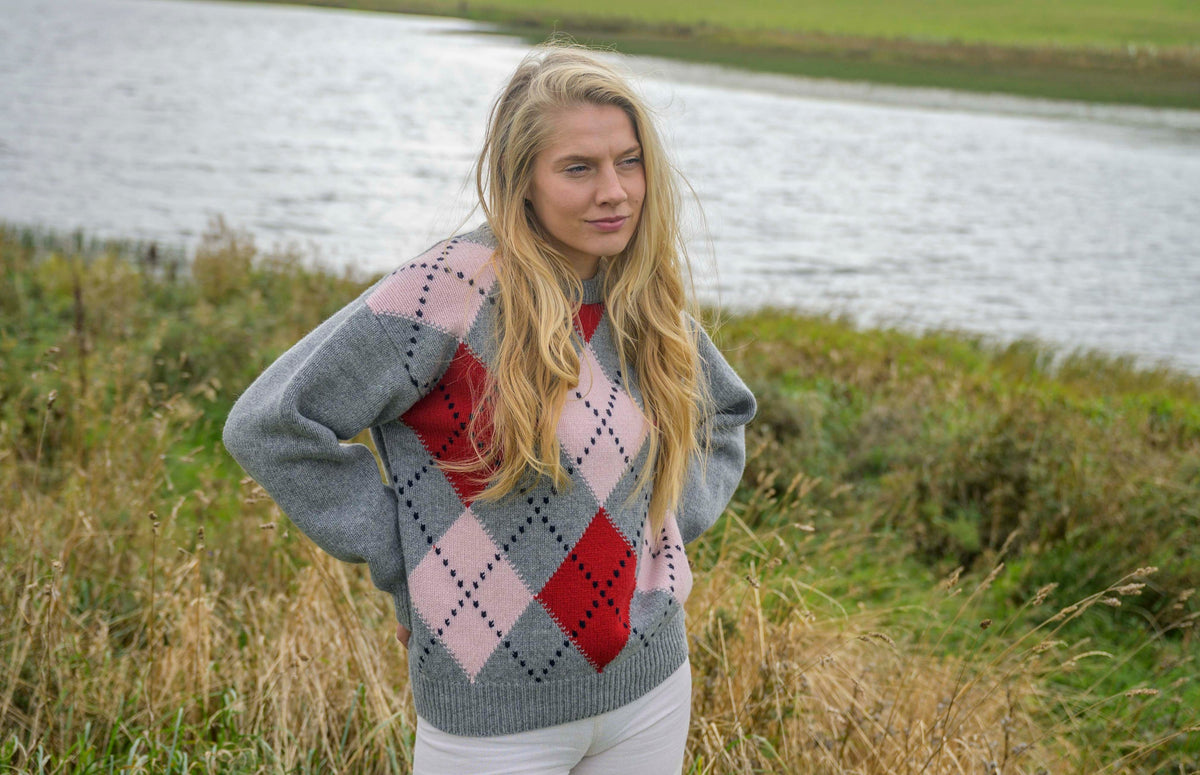
From the stocking frames of Hawick to handcrafted intarsia and today's fashion revival, the story of Argyle is woven into the history of Scottish knitwear. Teviot Knitwear’s MD Allan Godfrey, who formerly worked for Pringle of Scotland, discusses the fascinating origins of Argyle and its resurgence in the world of fashion today.
There are few patterns in knitwear as instantly recognisable as Argyle. Its diamonds and intersecting lines have become synonymous with golf, country clothing and classic British style - yet behind the familiar pattern lies a much richer story of Scottish craftsmanship, technological innovation and the extraordinary textile heritage of the Scottish Borders.
At the centre of that story is our town of Hawick, which has been long been regarded as Scotland's knitwear town.
From the stocking frames of the eighteenth century to sophisticated intarsia knitting and today's renewed enthusiasm for heritage knitwear, the history of Argyle is closely intertwined with the evolution of Scottish knitwear itself.

The Scottish origins of the diamond
The word Argyle is associated with Argyll in western Scotland, and the pattern's visual ancestry is generally connected with Scottish tartan and diamond motifs.
But the Argyle we recognise today isn't simply a tartan transferred onto a sweater. It evolved into a distinctive geometric pattern of diamonds, often crossed by diagonal lines, and was subsequently transformed by the knitting industry. This distinction is important.
Knitted Argyle became possible because manufacturers could use colour and knitting technology in increasingly sophisticated ways. Rather than weaving a patterned cloth and then cutting it into a garment, the design could be constructed directly within the knitted fabric. That opened the door to intarsia.
Intarsia: where the diamonds become part of the fabric
Handcrafted intarsia is one of the most beautiful techniques associated with patterned knitwear.
Instead of carrying several yarns continuously across the back of a garment, intarsia allows separate areas of colour to be knitted into particular sections. Each colour area has its own yarn supply, with the different sections joined as the knitting progresses.
For an Argyle sweater, this allows the individual diamonds to be built directly into the fabric. The effect is remarkably different from a printed design. The pattern isn't sitting on the garment - it is an integral part of its construction.
For a hand knitter, creating an intricate intarsia design requires careful attention to yarn management, tension and colour changes. In a luxury garment, these details contribute enormously to its character.
The technique also became a fascinating meeting point between handcraft and industrial innovation.
The Pringle story
One of the most important dates in the story is 1815, when Robert Pringle became involved in the business that would develop into Pringle of Scotland. The company began with hosiery and underwear, establishing its foundations in Hawick. Over the following decades, the business expanded into luxury knitwear and eventually became one of the world's most recognisable Scottish fashion names. The connection between Pringle and Argyle is particularly significant.
The Victoria and Albert Museum describes how Pringle developed specialised machinery capable of producing apparently seamless multicoloured intarsia designs and identifies the company's intarsia pattern as the basis of its signature Argyle. This was a remarkable development.
A traditional-looking pattern was being produced using highly sophisticated knitting technology in a Scottish Borders town with centuries of textile knowledge behind it.
A Duke, a golf course and an international fashion phenomenon
Argyle's transformation into a fashion icon was helped enormously by the Duke of Windsor.
His enthusiasm for colourful knitwear and golf gave Argyle a glamorous new identity during the first half of the twentieth century. Pringle itself notes that the Duke helped elevate the pattern to cult status, after which it was adopted by his fashionable circle.
The association with golf proved especially enduring. Argyle sweaters, socks and vests became part of the visual language of the golf course, particularly when worn with plus-fours or tailored trousers. But Argyle was no longer confined to Scotland. It became a symbol of sophisticated leisurewear and eventually entered mainstream international fashion.
Argyle and the fashion cycle
One of the extraordinary characteristics of Argyle is that it never completely disappears. And the pattern is once again having a strong moment.
It periodically returns to fashion, sometimes through traditional country dressing and sometimes through nostalgia for collegiate and preppy styles. Designers have repeatedly enlarged the diamonds, changed the colours and altered the proportions. The result can be surprisingly different from the classic golf sweater while still being instantly recognisable as Argyle.
Current 2026 knitwear coverage highlights the continuing importance of heritage-inspired sweaters and colourful knitwear, while contemporary retail collections are again featuring Argyle in modern wardrobes.

Argyle today: heritage meets modern fashion - Today's Argyle is less restricted by the rules that once surrounded it.
Oversized diamonds - Large-scale diamonds can turn the traditional motif into a bold graphic statement, particularly on relaxed sweaters and cardigans.
Unexpected colour - Traditional greens, creams, burgundies and navy are being joined by brighter and more unconventional colour combinations.
The oversized sweater -The fitted golf sweater has given way to relaxed silhouettes, making Argyle feel less formal and more contemporary.
The knitted tank - The revival of the knitted tank has provided another natural home for Argyle. Worn over shirts, dresses or T-shirts, the tank offers a modern interpretation of the traditional sleeveless sweater.
Vintage-inspired styling - Argyle works particularly well with contemporary interpretations of 1970s, 1980s and 1990s fashion.
Handcrafted intarsia - Perhaps most importantly, there is renewed interest in the actual making of knitwear. In a world of mass-produced printed patterns, individually constructed intarsia offers something distinctive: visible craftsmanship.
A pattern with a future
Argyle has travelled a long way from its Scottish origins. It has appeared on golf courses, in country houses, on university campuses, in Hollywood wardrobes and on international fashion runways. Yet its strongest connection remains with the craft traditions that gave it life.
The Scottish Borders provided the environment in which knitwear technology and craftsmanship could develop side by side. Hawick became one of Britain's great knitting towns. Companies such as Pringle transformed Scottish knitwear into an international luxury product. And intarsia gave Argyle its most distinctive knitted expression.
Today, designers can reinterpret the pattern almost endlessly - making the diamonds bigger, brighter, softer, sharper or deliberately imperfect. But the fundamental idea remains beautifully simple.
Colour becomes pattern. Pattern becomes fabric. And fabric becomes a piece of Scottish textile history. That is perhaps why Argyle has endured for so long. It isn't simply a pattern. It is a reminder of the ingenuity, craftsmanship and design heritage of Scotland's knitwear towns - and nowhere is that story more deeply woven into the landscape than in Hawick in the Scottish Borders.


